
V-belts remain one of the most widely used power transmission solutions in industry. From conveyor systems and pumps to compressors and agricultural equipment, the right V-belt can improve efficiency, reduce downtime, and extend the life of your machinery. Choosing the wrong type, however, can lead to slip, premature wear, and costly unplanned stoppages. Here’s a practical guide to common V-belt types and where they fit best.
Classical V-belts are the traditional workhorses. They have a trapezoidal cross-section and are built for general-purpose drives in factories, agriculture, and mining. Classical belts handle moderate loads and speeds well and are often used in multi-belt drives where several belts share a pulley. They suit applications where cost-effectiveness and broad availability matter more than maximum power density. If your drive has been running on classical belts for years and replacement availability is important, sticking with a quality classical belt is often the right call.
Narrow V-belts offer higher power capacity in a smaller cross-section. They can transmit more power than classical belts of similar width, which allows for more compact drives and smaller pulley diameters. Narrow belts are a good choice when space is limited or when you want to upgrade an existing drive without changing pulley sizes. They also tend to run cooler and last longer under comparable conditions. Many modern industrial and automotive applications have moved to narrow profiles for this reason.
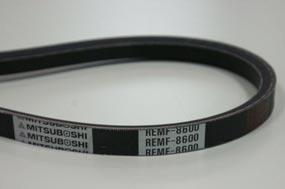
Raw-edge (or raw-side) V-belts have untreated sides instead of wrapped fabric. The raw rubber contacts the pulley groove directly, improving grip and reducing slip. This design often delivers better efficiency and allows higher tension without excessive wear. Raw-edge belts are commonly used in demanding applications such as industrial machinery, automotive accessories, and HVAC systems where reliability and efficiency are priorities. Mitsuboshi’s REMF range is a well-known example of raw-edge belts trusted in Australian industry.
Cogged or notched V-belts have grooves on the inner side that run perpendicular to the belt length. These notches increase flexibility, so the belt bends more easily around small pulleys and runs cooler. Cogged belts are well suited to drives with small-diameter pulleys, high-speed ratios, or applications with frequent start-stop cycles. The trade-off is that they can be more sensitive to misalignment, so proper installation and tensioning are important. When used correctly, they can extend belt life and reduce heat build-up compared to standard wrapped belts.
Choosing the right belt depends on your drive design, load, speed, and environment. Factors to consider include pulley diameters, centre distance, horsepower, and whether the drive is exposed to oil, heat, or moisture. Using the wrong type can lead to premature failure, slip, or noise. If you’re unsure, it’s worth consulting your supplier or checking the original equipment manufacturer’s recommendations before switching belt types.
Installation and tensioning matter as much as belt selection. New belts should be tensioned to the manufacturer’s specification and re-checked after a short run-in period, as initial stretch can reduce tension. Multi-belt drives should use matched sets to ensure even load sharing. Proper alignment of pulleys will maximise belt life regardless of which type you choose.
At UMS Trans, we supply a range of high-quality V-belts including Mitsuboshi REMF raw-edge belts and other proven products. Our team can help you match the right belt type to your application for reliable, efficient power transmission across Australian industry. Contact us for sizing, availability, and technical support.