
Key takeaways
- Pitch — the centre-to-centre tooth distance — is the first parameter of any synchronous drive, and it must match the pulleys exactly. There is no 'close enough'.
- Profile matters as much as pitch: trapezoidal (MXL/L/H) and curvilinear (HTD/GX) teeth do not interchange even at the same pitch.
- Identify an existing belt by measuring across ten teeth and dividing by ten, then decode the part number (pitch — length — width).
- For high-torque drives, Mitsuboshi's Giga Torque GX profile carries substantially more than standard HTD at the same size — often saving a pitch or width class.

Why pitch comes first
A V-belt forgives: run it slightly off-spec and it slips a little and wears a little faster. A timing belt does not — its teeth mesh with the pulley like a gear, which is the whole point of a synchronous drive. Get the pitch wrong by even one class and the teeth ride the pulley lands, skip under load, and shear off within hours.
So identification and selection both start with the same question: what is the pitch? Everything else — length, width, construction — follows.
Trapezoidal vs curvilinear teeth
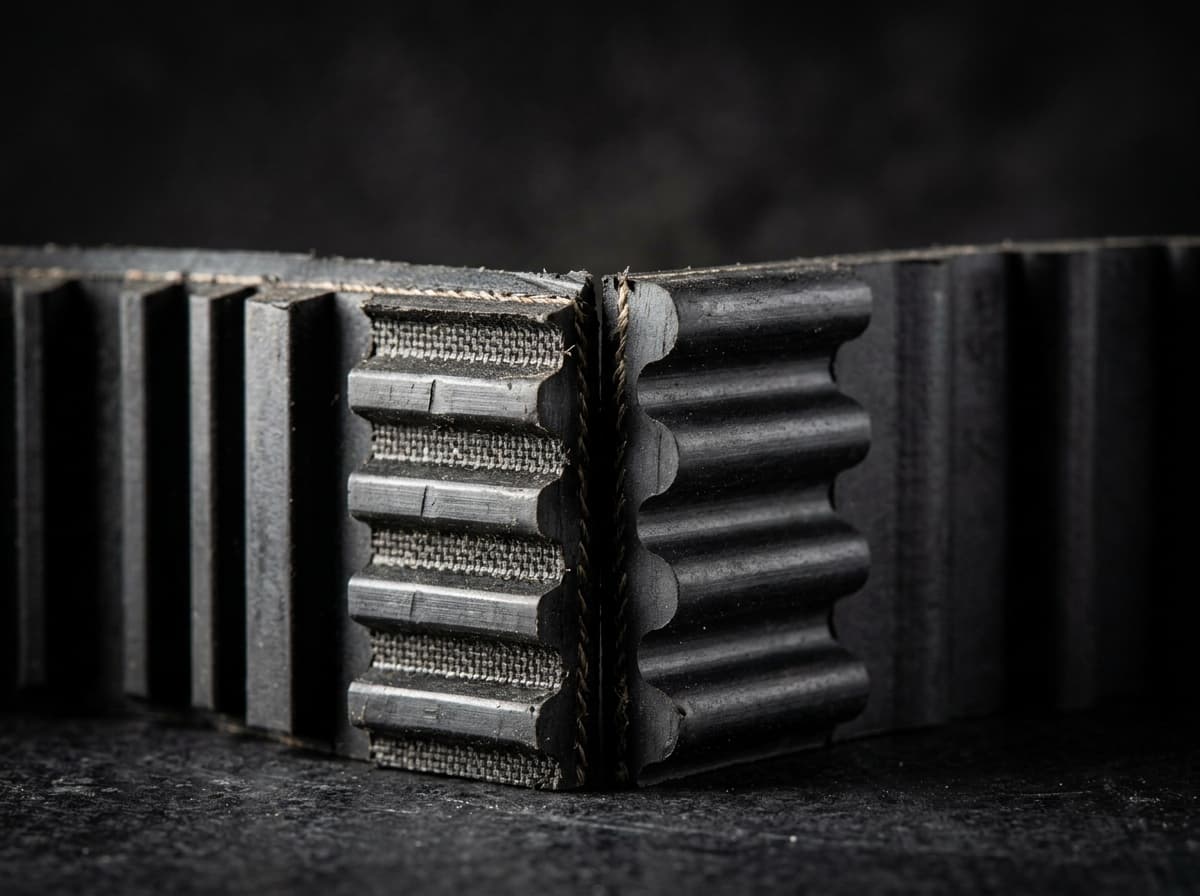
Two tooth geometries dominate. Trapezoidal profiles (MXL, XL, L, H — the classic imperial series) have flat-sided teeth; they are the legacy standard and still everywhere on older machines and light drives. Curvilinear profiles (HTD and its high-torque descendants like Mitsuboshi's Giga Torque GX) use rounded teeth that spread load across the whole tooth flank instead of concentrating it at the root — the geometry that unlocks serious torque.
The pitch table
| Designation | Pitch | Profile | Typical duty |
|---|---|---|---|
| MXL | 2.032 mm | Trapezoidal | Instruments, office equipment, tiny actuators |
| XL | 5.08 mm | Trapezoidal | Light machinery, small positioning drives |
| L | 9.525 mm | Trapezoidal | Light-to-medium industrial drives |
| H | 12.7 mm | Trapezoidal | Medium industrial drives, legacy machinery |
| 3M | 3 mm | Curvilinear (HTD) | Small high-speed drives, medical, robotics |
| 5M | 5 mm | Curvilinear (HTD) | General light industrial, packaging |
| 8M | 8 mm | Curvilinear (HTD) | The industrial workhorse — pumps, conveyors, machine drives |
| 14M | 14 mm | Curvilinear (HTD) | Heavy drives — crushers, mills, large conveyors |
| 8MGX / 14MGX | 8 / 14 mm | High-torque GX | Shock-loaded and torque-limited drives; replaces wider standard belts |
Common industrial timing belt pitches and where they are used.
8M is the default; GX is the upgrade path.
Identify an existing belt
Measure the pitch: set calipers centre-to-centre across adjacent teeth. For accuracy, span ten tooth intervals and divide by ten — small pitches are hard to read singly and 2.032 vs 3 mm matters.
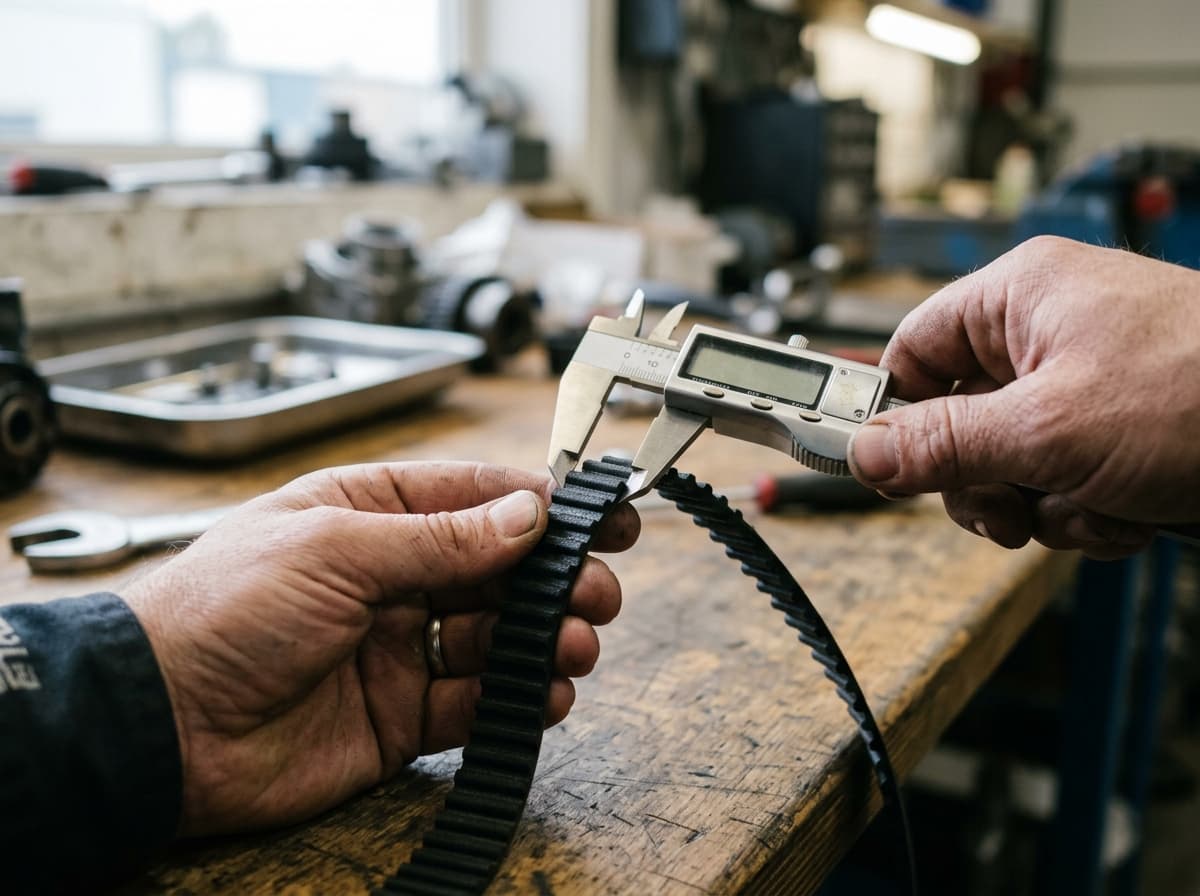
Check the profile: flat-sided teeth are trapezoidal; rounded are curvilinear. Then decode or rebuild the part number:
| Example | Reads as | Meaning |
|---|---|---|
| 8M-1600-20 | pitch · pitch length · width (mm) | 8 mm pitch · 1,600 mm long (200 teeth) · 20 mm wide |
| 14M-2310-40 | pitch · pitch length · width (mm) | 14 mm pitch · 2,310 mm long (165 teeth) · 40 mm wide |
| 450L050 | length · pitch class · width (imperial) | 45.0″ pitch length · L pitch (9.525 mm) · 0.50″ wide |
| 150XL037 | length · pitch class · width (imperial) | 15.0″ pitch length · XL pitch (5.08 mm) · 0.375″ wide |
Reading a timing belt part number.
Tooth count is the cross-check: teeth × pitch = pitch length. If your count and measurement disagree with the printed code, trust the measurement — and confirm the match against the pulley, exactly as with V-belt cross-referencing.
Selecting pitch for a new drive
For a new synchronous drive, pitch follows torque and speed. The working shortcuts: small, fast, low-torque drives sit at 3M/5M; the broad industrial middle belongs to 8M; genuinely heavy torque pushes to 14M — unless a GX profile at 8M carries it first. Wider belts add capacity linearly, but stepping up a pitch adds more capacity than widening, at the cost of bigger pulleys.
Send us the torque (or motor kW and rpm), the speeds, and the centre distance, and we size the pitch, width and length against the Mitsuboshi timing range — including whether GX earns its premium on your numbers.

Frequently asked questions
How do I measure timing belt pitch?
Measure centre-to-centre between two adjacent teeth with calipers. For better accuracy, measure across ten tooth intervals and divide by ten — an 80 mm reading across ten gaps is an 8 mm pitch belt.
Can an HTD belt run on trapezoidal pulleys (or vice versa)?
No. Tooth profiles must match the pulley exactly — a curvilinear tooth in a trapezoidal groove contacts on the tips, skips under load and destroys itself quickly. Pitch AND profile both have to match.
What does a timing belt part number like 8M-1600-20 mean?
Pitch — pitch length — width, all in millimetres: 8 mm tooth pitch, 1,600 mm circumference (200 teeth), 20 mm wide. Imperial belts read differently: 450L050 is a 45.0-inch pitch length, L pitch (9.525 mm), 0.50 inch wide.
When should I choose Giga Torque GX over standard HTD?
When torque is the constraint: GX's high-load curvilinear profile carries substantially more than standard HTD at the same pitch and width, so drives can come down a pitch or width class — or survive shock loads that shear standard teeth. Common in crushers, mixers and heavily loaded conveyors.
Synchronous drive to size or match?
Pitch, torque, speeds — or just a photo of the old belt. We'll come back with the exact Mitsuboshi timing belt and Australian stock position.