
Key takeaways
- V-belt sections are standardised internationally — an SPB is an SPB from every manufacturer, so brand-to-brand matching is a decoding job, not a guessing game.
- Decode the old part number into two facts: section and length. If the print is gone, three measurements rebuild it.
- Match construction too: wrapped, cogged (raw-edge) and banded belts cross-reference within their own type.
- Replace multi-belt sets complete, from one manufacturer — mixed sets share load unevenly and fail early.
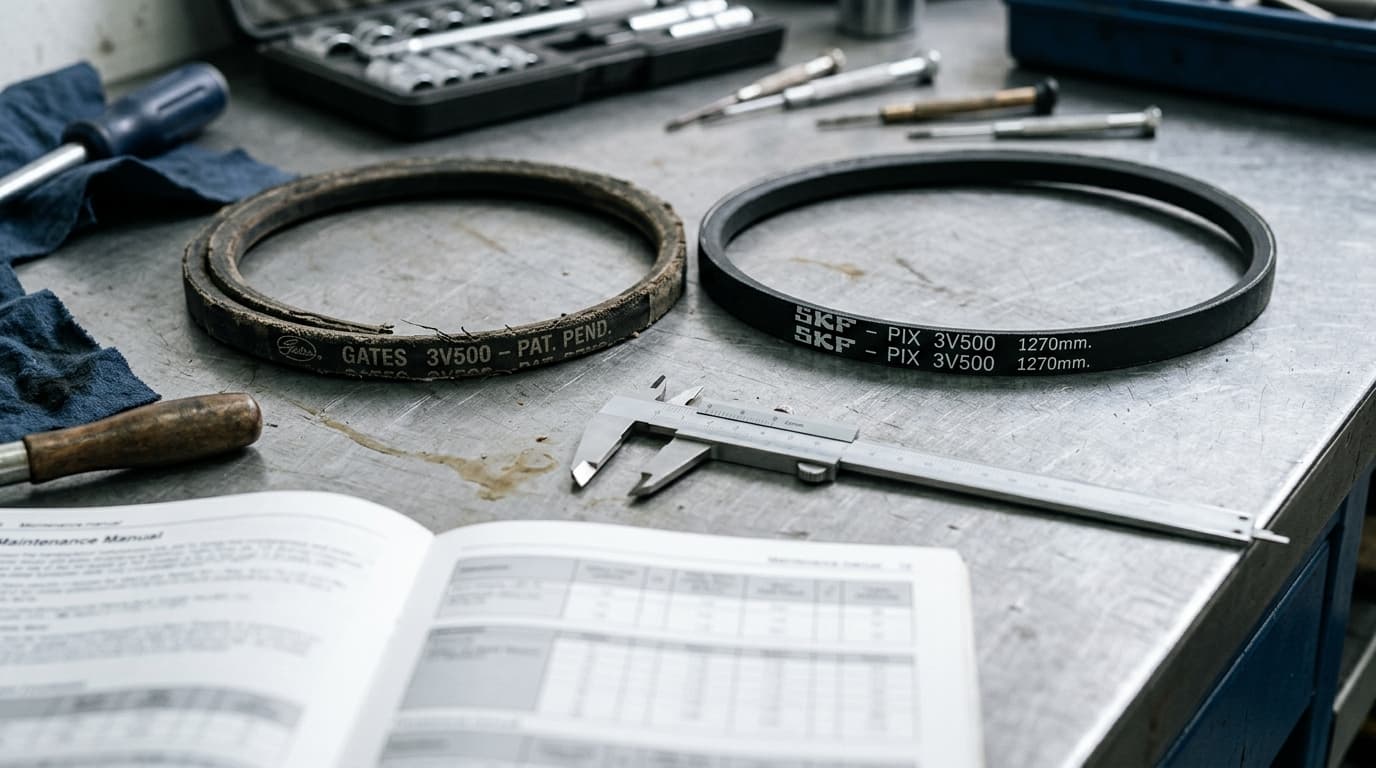
Why cross-referencing works
V-belts look proprietary but are anything but. Cross-sections, groove angles and length designations are fixed by international standards — ISO 4184 and DIN 2215 for classical belts, DIN 7753 for narrow wedge belts. A B71 or an SPA1800 describes exactly the same physical belt whether the sidewall says Gates, Optibelt or Mitsuboshi.
That means the belt on your machine right now — whatever brand it is — can almost always be matched to a Mitsuboshi equivalent held in Australian stock. What changes between brands is construction quality, cord material and consistency, not the dimensional system.
Decode the part number
Most belt codes follow one of a handful of patterns. Find yours in the table and you have the section and length immediately:
| Example code | System | How to read it |
|---|---|---|
| A47 | Classical (inch) | A section · 47″ nominal inside length |
| B1800Li | Classical (metric) | B section · 1,800 mm inside length |
| SPB2240 | Narrow / wedge (DIN 7753) | SPB section · 2,240 mm pitch length |
| 3V600 / 5V1250 | US wedge | 3V/5V/8V section · length in tenths of an inch (600 = 60″) |
| 6PK1540 | Ribbed (Ribstar) | 6 ribs · PK profile · 1,540 mm effective length |
| 8M-1600-20 | Timing (HTD/GX) | 8 mm pitch · 1,600 mm pitch length · 20 mm wide |
Common V-belt and timing belt designation systems and how to read them.
Brand series equivalents
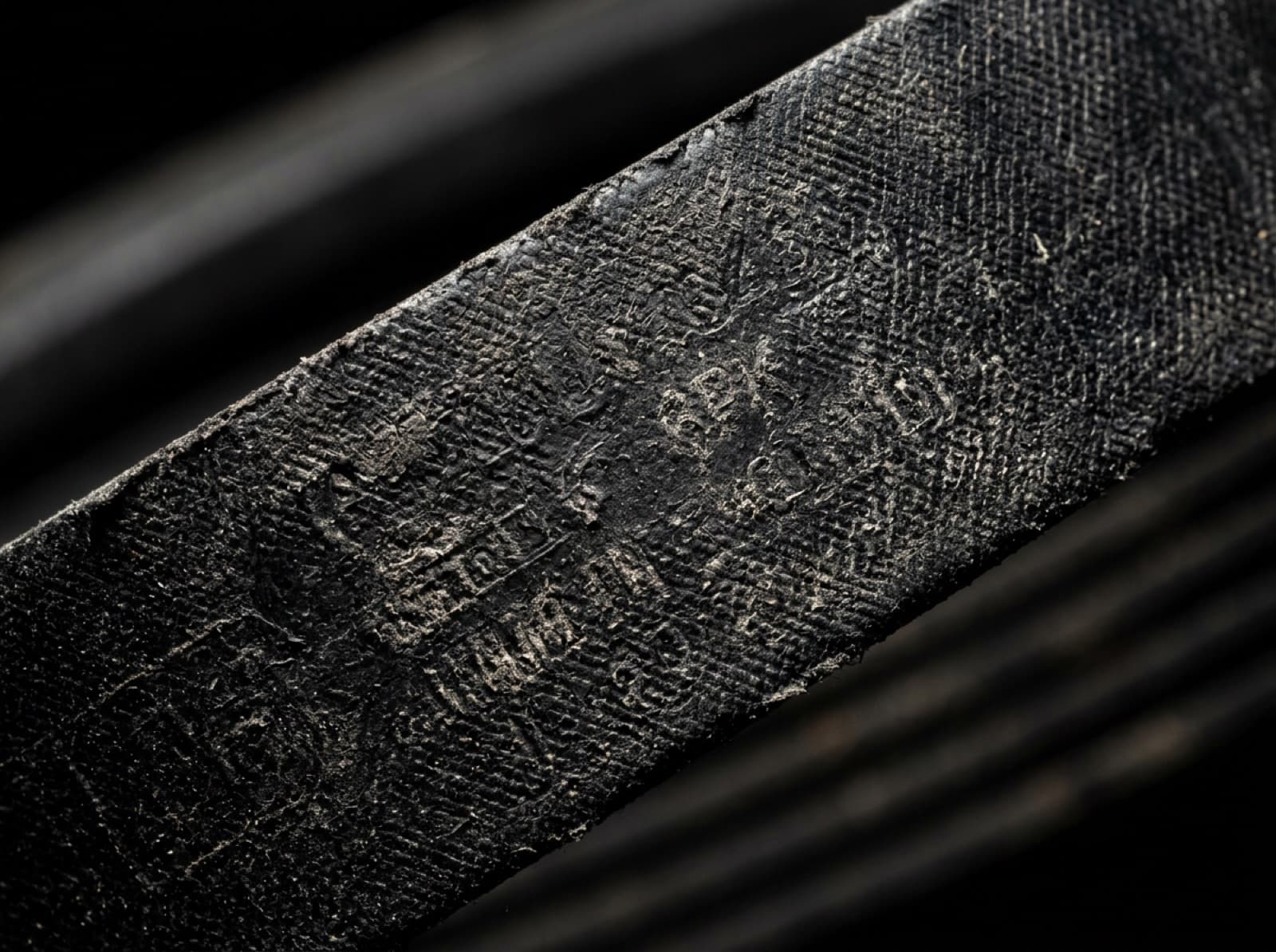
Manufacturers wrap the same standard sections in their own series branding. This is how the common series map to the Mitsuboshi range we stock:
| Belt type | Commonly seen as | Mitsuboshi range at UMS |
|---|---|---|
| Classical wrapped (A, B, C, D) | Gates Hi-Power, Optibelt VB | Classical V-Belts |
| Narrow wedge (SPZ–SPC) | Gates Super HC, Optibelt SK | Narrow V-Belts |
| Ribbed / multi-rib (PK) | Gates Micro-V, Optibelt RB | Ribstar / V-Ribbed |
| Timing — trapezoidal & HTD | Gates PowerGrip, Optibelt Omega | Timing Belts |
| Timing — high-torque curvilinear | Gates PowerGrip GT | Giga Torque GX |
| Agricultural profiles | OEM & bespoke codes | Agricultural Belts |
Indicative series mapping — always confirm section and length; series names change between markets.
Series names are marketing; sections are physics.
Confirm the match with three measurements
Whether you decoded a part number or started from a blank belt, confirm before ordering. Three measurements make the match certain:
1 — Top width, with calipers across the widest face. 2 — Height, from top face to base. Together these two give the section.
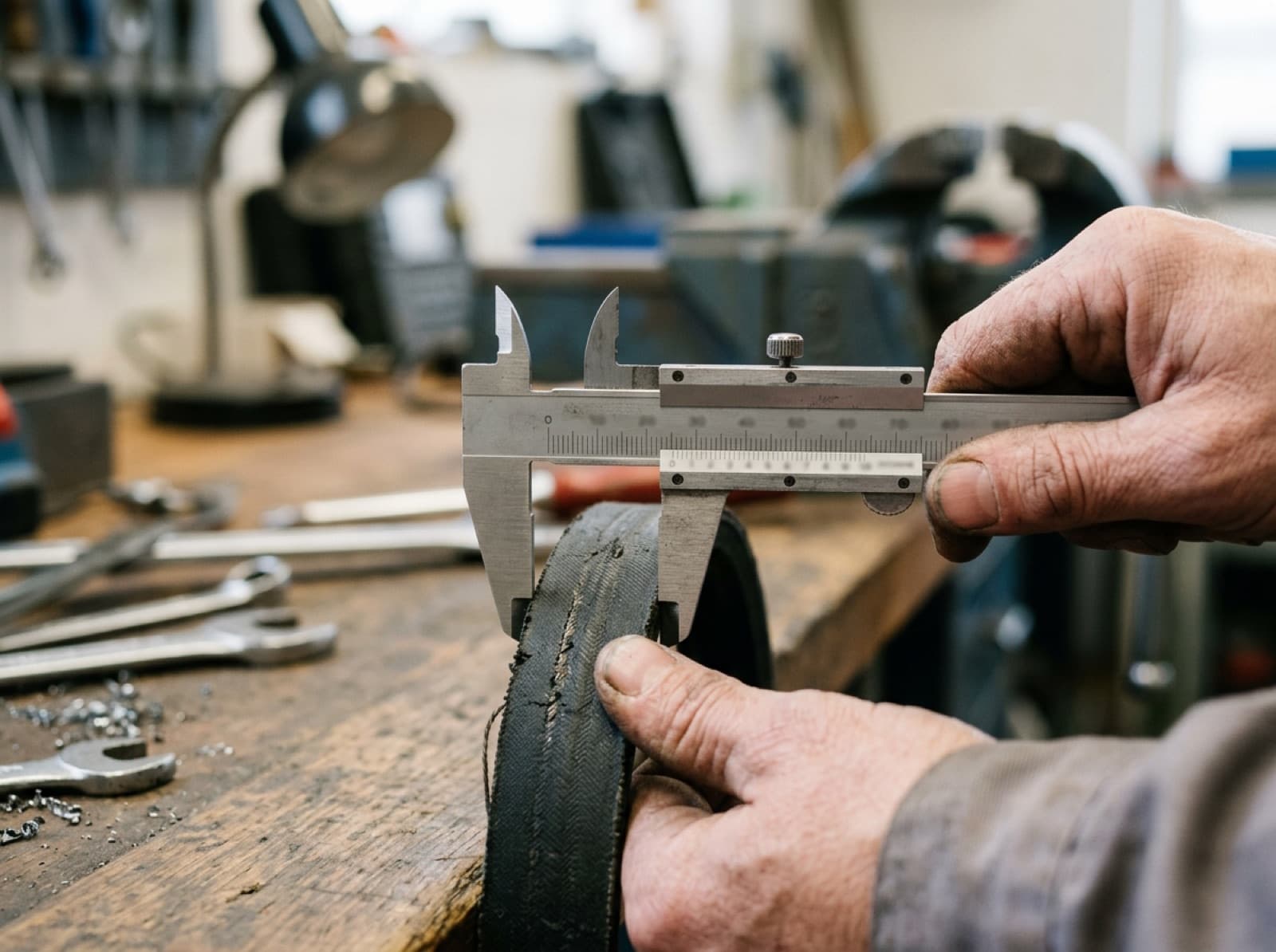
3 — Length, with a cloth tape around the outside (our size chart guide covers converting that to the nominal designation). Then hold old against new: profiles should sit flush, lengths within tolerance.

If any measurement sits between sizes — or the belt is from an unusual OEM system — send us the three numbers and a photo. Matching odd belts is daily work for our team, and the answer usually comes back the same day.
When not to cross-reference
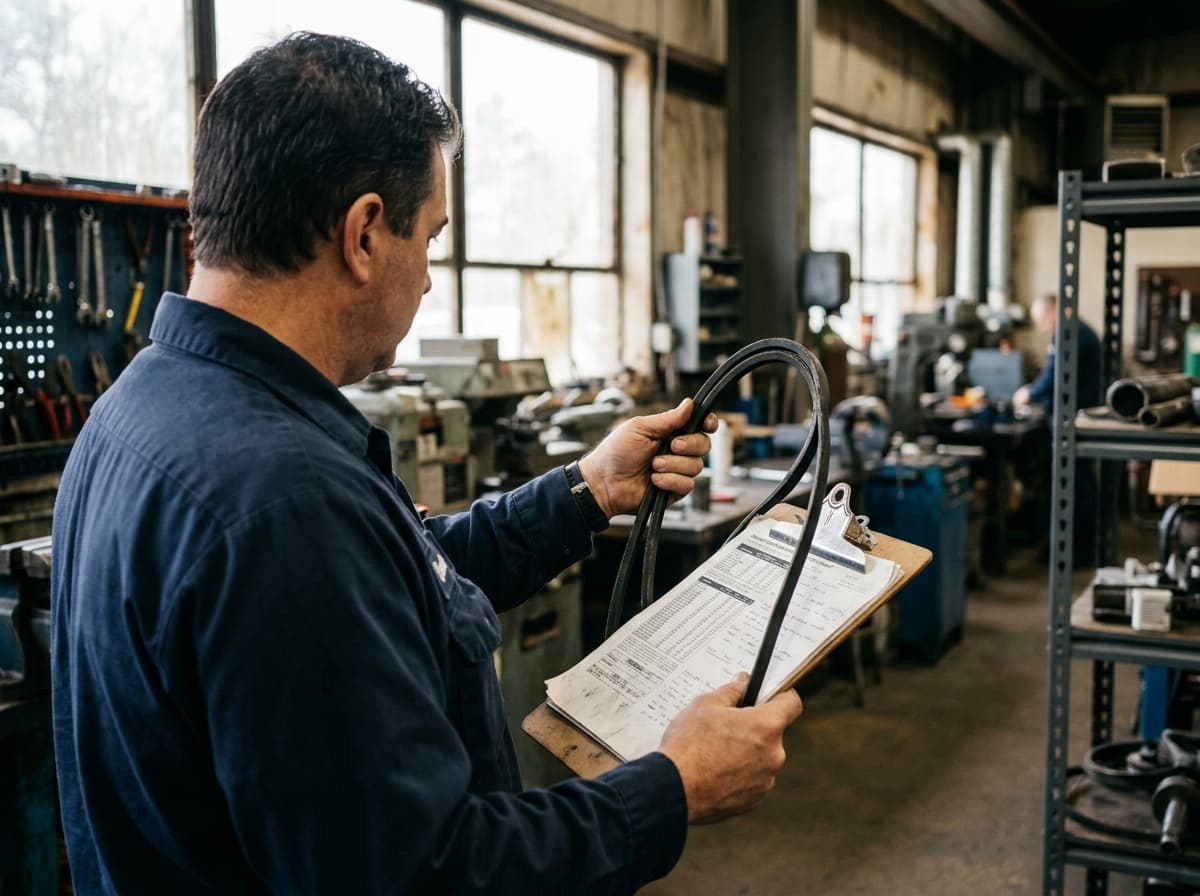
A few belts should be matched by application rather than dimensions alone: banded (joined) sets, aramid/Kevlar-corded belts on shock-loaded drives, variable-speed belts, and OEM automotive belts with model-specific profiles. For these, quote the machine or vehicle application along with the measurements — the agricultural range in particular has application-specific constructions that look dimensionally identical but differ in cord and cover.
Frequently asked questions
Can I replace a Gates or Optibelt V-belt with a Mitsuboshi one?
Yes, in almost all standard cases. V-belt sections are defined by international standards (ISO 4184, DIN 2215/7753), so an SPB2240 from any reputable maker has the same section and pitch length. Match the section and length, and check the belt is the same construction type (wrapped, cogged/raw-edge, or banded).
The part number on my belt is unreadable. Can I still cross-reference it?
Yes — the part number is just a compressed description of measurements you can take yourself: top width, height, and length. Measure those three and you have effectively rebuilt the part number. Our size chart guide walks through the method.
Do I need to replace all belts in a multi-belt drive at once?
Yes. Belts in a set share load based on identical length and wear. A new belt paired with stretched old ones carries a disproportionate share and fails early. Replace the full set with belts from one manufacturer.
What is the difference between a wrapped and a cogged (raw-edge) belt?
A wrapped belt has a fabric cover; a cogged belt has exposed rubber flanks with moulded notches that let it bend around smaller pulleys and run cooler. They cross-reference by the same section codes, but keep the same construction as the original unless the drive is being re-engineered.
Send us the old part number — we'll do the rest
Any brand, any code, even a blank belt with three measurements. We'll confirm the Mitsuboshi equivalent and Australian stock the same day.